When a garage door won’t open, most homeowners immediately assume the opener is broken. In reality, the two most common causes are a failed spring or an opener safety issue—and the fix depends on knowing which one you’re dealing with. This fast checklist helps you diagnose the problem safely before you risk damaging the door, the opener, or yourself.
Quick Answer
If your garage door feels extremely heavy, only lifts a few inches, or you hear a loud bang, the problem is almost always the spring.
If the door lifts smoothly by hand but won’t move when using the opener, the issue is usually the opener, sensors, or settings.
Important: Never force the opener to lift a heavy door. This often turns a small repair into a much bigger one.
Safety First (Don’t Skip This)
Garage doors typically weigh 150–300+ lbs. Springs carry that weight. When a spring fails, the opener is suddenly trying to lift the full load.
Stop troubleshooting immediately if:
- The door is crooked
- Cables look loose or off
- The door is stuck halfway open
These are injury-risk situations.
Fast Checklist: Spring vs Opener
Step 1: Disconnect the Opener
Only do this if the door is fully closed.
- Unplug the opener.
- Pull the red emergency release cord.
- Try lifting the door manually using both hands.
What happens next tells you almost everything.
Result A: Door Is Extremely Heavy or Won’t Lift
Most likely cause: Broken spring. You can learn more in this garage door spring replacement guide.
Common signs:
- Door lifts 6–12 inches then drops
- Door feels impossible to lift
- You heard a loud bang earlier
- Visible gap in the torsion spring above the door
- One extension spring is hanging or stretched
Stop here. Do not reconnect the opener or keep testing.
Result B: Door Lifts Smoothly and Stays Halfway Open
Most likely cause: Opener or safety system
The door itself is balanced correctly, which means the spring is doing its job.
Opener-Related Clues (If the Door Is Balanced)
Look for these common opener issues:
- Opener hums but door doesn’t move → stripped gear, jam, or disengaged trolley
- Opener runs, but nothing happens → release cord not reconnected
- Lights flash or clicking sounds → safety sensor issue
- Door starts then reverses → force or travel limits out of adjustment
Quick things you can safely check:
- Power outlet and breaker
- Remote battery
- Wall control lock/vacation mode
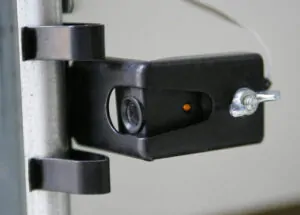
- Photo-eye sensors (clean lenses, steady LED lights)
- Obstructions near the floor or tracks
If the door works manually but not with the opener, the opener needs service—not the spring.
Symptom → Most Likely Cause
- Door won’t lift manually → Broken spring
- Door opens a few inches then stops → Spring or cable issue
- Opener runs, door doesn’t move → Spring failure or opener disconnect
- Door reverses when closing → Sensor alignment
- Door lifts unevenly or crooked → Cable off drum (urgent)
Winter & Edge-Case Problems
In colder months, doors may freeze to the floor due to ice buildup. If the opener strains but the door won’t budge, don’t force it—you can damage the spring or opener.
Other less common causes include engaged manual locks, bent tracks, or seized rollers.
When to Call a Professional Immediately
Call for service if:
- You see a broken spring
- The door is crooked or jerking
- Cables are loose or frayed
- The door is stuck halfway open
- The opener is straining or grinding
Delaying repairs often causes secondary damage that costs more to fix.

Final Word
Most “garage door won’t open” calls come down to one question: Is the door balanced or not?
Heavy door = spring problem.
Balanced door = opener or safety system.
If you’re unsure or see warning signs, stop and book a professional inspection. A correct diagnosis protects your door, your opener, and your safety.
Need same-day help in the GTA?
Call (437) 873-1407 or book online at motiongaragedoors.ca
Your Garage. Our Motion.